
Do you have someone you talk with about ideas, insights, and possibilities?
 I’m grateful that I do. In fact, many of the people I spend time talking with enrich me and my life through our discussions. I gravitate away from people who insist on talking about their aches and pains, awful politics, local gossip, and their own complaint-du-jour. I can claim this healthy habit as a consistent daily practice, and the payoff is so positive. (Manage the vibe!)
So last summer, I’m walking on the beach in the Abacos with my favorite conversation partner and the subject of “attention” comes up as we (in that idyllic environment) notice how natural it is to be “present.” There, it’s easy to notice the breeze on your face, the smell of the sea, the beauty of the aqua blue water.
Still, the mind resists settling down—To-Do items barge in, weather worries arise, and judgments jump up when other people arrive in “my” space. As my friend and I talk about the bane of distraction, I say, “My author client Eric Wilson has the most interesting perspectives on this. He’s writing a book all about ‘attention.’ He calls moments like this when we are really present the ‘Flow State.’”
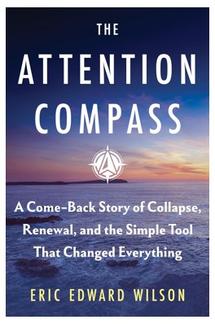
One of his key points is so powerful that I recall it easily and share it: Imagine a compass showing North, South, East, and West as attention-pulling directions. North represents identity concerns—thoughts about who you are or should be. South is comparative thinking—measuring yourself against others or your own expectations. West hijacks you into the past—regrets, nostalgia, grudges. East pulls you into the future—planning, worrying, or fantasizing about what might happen.
Above this compass hangs a plumb bob—a weighted object suspended on a string, like they use in construction to find true vertical. This plumb bob represents your current focus of attention. When it's centered, your awareness rests in the present. When it swings toward any of the four directions, your attention has been captured by a particular pattern of thought or emotion.
I don’t think my attention is usually pulled North or South nearly as often as it is East or West. Especially West—I’m a worrier. My friend recognizes her own patterns, too. I tell her she’s going to love this book when it comes out because it will include a proven, simple tool to use when you want to bring your attention back to center.
And now…we’ve published The Attention Compass: A Come-Back Story of Collapse, Renewal, and the Simple Tool that Changed Everything. Check it out!








Comments